Sunday, 17 August 2014

A Book to Read on Your Holiers

Posted By Daisy


Dingle Harbour

THIS SUMMER, I spent almost three weeks in Ireland. With fabulous weather (it rained twice) and lots of my friends and family around, there's nowhere I would rather have been.

A guy in the nightclub told me I didn't look a day over 37...arghhhh. I blame the over-zealous bouncy blowdry.

In Cork, I met people for coffee and burritos, and spent lazy afternoons drinking beer in the sun. We did laps of the spa pool and snuggled into robes for chats and snoozes on the heated beds before folding chocolate brownies into our mouths during afternoon tea.


Dee's husband does an amazing BBQ- but gets FURIOUS if you open two boxes of tea at the same time.
 'You know that Barry's Tea isn't actually grown in Cork,'  he says.

 
In Dublin, I ate barbecued corn on the cob with butter dripping down my chin, drank 'Away with the Fairies' cocktails (the phrase my family uses to describe me) in Fade Street Social, and danced to old favourites in Whelans. We took a stroll through centuries of Irish history collected in a three-storey Georgian townhouse in the Little Museum of Dublin, and ate Croque Madame in the Powerscourt Centre.

Treasures at the lovely Little Museum of Dublin
Reminders of the good times during the Boom: Gold-Plated Monster Munch by Caroline McCarthy (2011), and the non-ironic 'Nouveau' magazine which folded after one issue. Cover tag lines included 'Dirty Filthy Lucre: And how to Make More' and 'Champagne Powder: Skiing with the Rich'.


We sat on the faded couch of our house in Dingle, eating crisps, reading magazines and drinking beers.
 We drank rose in plastic glasses while throwing down confident fivers at the races. We listened to incongruous techno  in a secret beer garden, and shot the breeze with lots of chatty drunken strangers, one of whom insisted on walking us home.

I did a dance of terror one morning, as I reached into the box of teabags to find a spider hiding inside and begged M to get rid of it.

I read my book and drank coffee while looking at the amazing scenery at Tig Slea Head, and later we sat in the car smiling at the screams of laughter from a trio of women struggling to get dressed on the beach as a flashstorm blew around them for ten minutes before the sun returned.

I saw Fungi the dolphin from an old fishing boat, and watched G's children making pottery at Dun Chaoin.


'A Rainy Day in Dingle' by Tom Roche
 
I drank crab bisque and walked the deserted beach at Smerwick Harbour with my mother, and ate porridge with cream and fresh fruit compote, and smoked mackerel and blue cheese for breakfast in Benners hotel. I also had a big argument with her over dinner one night (too much wine) and almost walked out of the restaurant. Although, I can’t even remember what it was about now.
 
 
Mini Dingle Tourist Guide:
 Best Cream Slice: Courtney's Bakery (have it with a coffee in the little courtyard)
Best Restaurant (and I've tried most of them over the years): The Global Village
Best Beach Walk: Smerwick
Best View of the Blasket Islands from a Café: Tig Slea Head
Best View of the Sleeping Giant: Clogher strand
Best Pub: Foxy Johns
Best Hidden Beer Garden: Adams Bar
Best Lunch on a Sunny Day: Fish at the Marina
Best fresh scampi and chips: Harringtons chipper
Best Tourist Destination fairly near to town: Pedlar's Lake, Conor Pass

I watched 'Mortified Nation' on Netflix (hilarious) and spent a nostalgic afternoon reading through old diaries in a big box in my mum's house.
 
This is where it all started, aged 15. Big mistake. Huge.
'Guess what. I did it. I smoked my very first cigarette!!.....Actually it was rather gross but we're going to do it again tomorrow.'

Before I knew it, I was on the flight back to London, having a vodka and coke and a cheeseboard and feeling a bit sad while scrolling through my holiday phone pictures.

 
Elevator Pitch: One day, Dr Yvonne Carmichael does something risky. And discovers she likes it.
When something terrible happens to her one evening, she is forced to reveal her recent activities, and ends up exposing uncomfortable truths that may destroy her hitherto ordinary life.
 
It's a cold, uncomfortable thriller, but somehow, even though I read it ages ago, I still remember it very well.
 
(I'm being deliberately very vague but don't want to ruin such a compelling story for anyone who has yet to read it.)


Tuesday, 8 July 2014

A Book to Read on a Midsummer's Evening

Posted By Daisy


ONE of my oldest friends got married at the weekend. On an estate in the middle of the West Cork countryside, under blue skies in the heat of the midday sun.
 
Guests sat on rugs dotted around the lawns, shoes off and legs stretched out in front of them, as L and B walked casually (with smiles so wide) to the waiting celebrant. Wearing a fairy-queen dress (which she only tried on for the first time an hour before the wedding), L smiled calmly and patted the dog as her husband to be (wearing a bell bottomed suit made by L) held her other hand.
 
 
They were blessed to the sounds of the bride’s father singing ‘She Moved Through The Fair’, his deep baritone carrying over the gushing river. Dogs ran amok, babies crawled towards them as the celebrant spoke, and in between the words, her brothers sang love songs and played the guitar.
 
Afterwards, we drank champagne in a clearing by the river, and ate sushi and sausages and smoked salmon and giant squashy eclairs filled with cream, and basked in the sun for the whole afternoon. The bridesmaid kicked off her heels and wore black lace up boots and socks with her sea-green dress and blond hair.


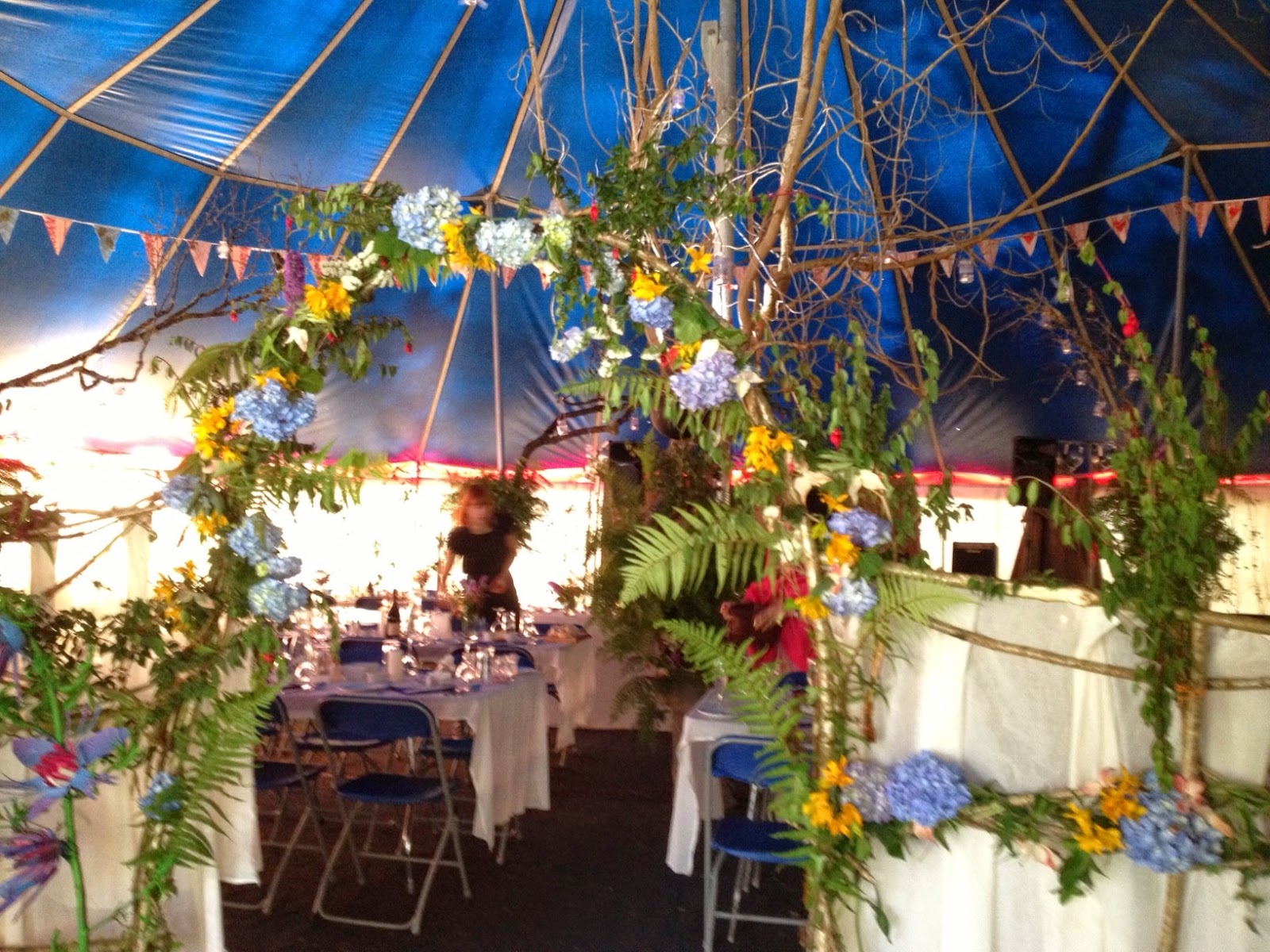
The wedding marquee was an old circus tent. They strung coloured bunting across the circumference of the tent. They threaded hydrangeas and bluebells and daisies and buttercups through a wooden bower, and filled jam jars with flowers and candles on every table.


They cut down huge branches from the forest nearby and strung tiny glass jars with tea lights with thread from the branches. Guests wrote good luck wishes on handmade labels and tied them with straw to an apple tree outside.
 
 
At dinner, we drank wine and feasted on hummus and pate and pea soup and buttery sea bass barbecued in tinfoil, and a pig on a spit. The wedding favours were wild flower bombs, to be planted in spring.

'It's like Robin Hood,' said someone, as two merry men carried a barrel of Guinness into the bar tent, and after-dinner guests began to arrive.


At dusk, citronella candles were lit, and lights strung across trees outside switched on and the bride donned a hooded silk-and-brocade dancing jacket. Inside the tent, dinner tables were pushed aside and the first of three bands began to play. Guests milled around outside and it felt like there was magic in the air and that anything could happen.

And maybe it did. A moment as fleeting and wispy as a midsummer nights dream. But it made me happy.


Elevator Pitch: A teenager and her brother live with their outwardly pious but tyrannical father and brow-beaten mother in a Nigeria that's changing every day. They soon realise that not everyone's life is this brutal and limited.
It's a cross between The Poisonwood Bible and any book by Alexander McCall Smith.
After reading a few chapters, I predicted that this would be one of the best books I had ever read. And although it didn't quite live up to early expectations (the ending is strange), it was still a great read nonetheless.
A young Nigerian man and his English wife spotted my mum reading it on the airport tube, and they chatted happily about Africa (she spent 9 years in Nigeria) the whole way from Heathrow to Hammersmith.
It was longlisted for the Booker Prize in 2004, and was Adichie's first novel. I look forward to reading her next novel, 'Half of A Yellow Sun'.
 

Wednesday, 18 June 2014

A Book to Read in Berlin

Posted By Daisy
 
 
I DID a strange thing last month. I headed off for a long weekend in Berlin with my friends – and didn’t pre-pitch a travel feature to my editor. I decided to relax and enjoy the city for what it was, without having to research the place to death, or take constant pictures on my phone and search for quirky little bits of colour.

Over the past seven years, I have learned a few tricks about being discreet while writing about a holiday with other people. I tap notes into my phone during the snooze-on-your-bed time before dinner. I take quick pictures of shop names or menus or interesting details on my phone before anyone has even realised.

Completely different to how I pictured it, Berlin is a laid back, hippy dippy, flower strewn, cobbled streets-mixed-with-Reichstag-type-buildings, friendlier-than-London, beautiful city that I would re-visit in a heartbeat.

Although it's seven times the size of Paris, it feels walkable and accessible and incredibly friendly. The U Bahn and S Bahn are simple to use and the cost of living is low.

We stayed in two Air BNB rental apartments on Kastanienallee, complete with coloured Ikea kitchens and low hanging ceiling lamps.


Kastanienallee: A gorgeous street right beside the U Bahn 'Eberswalder Strasse' stop, complete with gorgeous cafés with vintage chairs and good looking Germans in brogues and Wayfarers.

On the first evening, we drank wine and ate olives, bread sticks and chocolate. We listened to music and chatted late into the night. When we got up each morning, we pottered about drinking copious cups of tea and talked and laughed some more at the kitchen table.

We meandered down Kastanienalle, sitting on wooden benches eating falafels from a Lebanese restaurant.

After lunch, we stopped for small glasses of coffee and fed the tame birds that landed on our table with stray crumbs of carrot cake.
We window shopped in antique stores and gift shops and a cool Scandinavian shop and tried on cool German leather boots in Luca E Anna.


We paused at the hundreds of grey blocks at the Holocaust memorial, and visited the museum underneath. We read stories of Jewish families in the Room of Families and sat in the dark in the huge Room of Names, watching names of murdered or missing Jews from all over Europe flash up on the cinema screen. It would take almost seven years to watch all the names.
 
 
We wandered past the museum quarter and through Potsdamer Platz, and past the Brandenburg Gate, and monuments to masculinity on Museum Island where people sat by the river on deckchairs on the late afternoon sun.

We listened to an American Indian playing the pan pipes beside the Reichstag building.


Then we jumped on a U Bahn back to Kastanienallee for pizza and beers, and lolled about in the apartment until 1a.m. whereby someone shouted ‘Let’s get going’ and off we went for some DJ techno worshipping at the Watergate. In the smoking area, a young man in a sailor suit approached L, and said in a German accent - 'I have a huge cock ring, would you like to see it?'

To which she replied 'Ah stop, you look like a lovely young fellow, what would your mother say if she heard you talking like that?'

Nothing, it seems, fazes women in their thirties.


The next night, we ventured to Berghain. Located out of town in an abandoned power factory, Berghain has been described as the coolest club in the world. There’s an iPhone app for how to get into Berghain, and even a ‘How to ….for Dummies’ book. Famous bouncer, Sven Marquardt, guards the door at weekends, warning punters that there are no photos allowed inside. Inside, by all accounts, there are mattress upon which strangers pee on you, Dark Rooms for dark deeds, and a Great Room which lets in the early morning sun as the shutters open and close to the beat of the music, revealing a thousand pale clubbers faces every second thump.

Some of the girls had tried and failed to get in before, and they warned us of the rules:

·         No talking or giggling in the queue

·         Speak German

·         Wear black

Looking cool and Germanic with her black leather jacket and blonde hair, M arrived first at the door. When the bouncers asked her ‘Ein?, she unsmilingly said ‘Jaaaah’ in a German accent, and was promptly ushered inside. Where she told us the women security staff searched her underwear before leaving her to wander upstairs past topless men with hormone implants, the infamous Dark Rooms and scary death metal music.

The bouncer took one look at the rest of us (shushing each other and giggling) and said nicely ‘You will not be getting in tonight.’ Dreams shattered, I asked him ‘Could we just get a selfie with Sven?’ Registering a brief surprise on his face, he rallied fast, replying calmly ‘There will be no selfie tonight.’

With 5 out of 6 refused entry, M reluctantly left the building and we went to Golden Gate club (under some railway arches) until 6 a.m. Two of the girls stayed there until 2p.m. that afternoon.
 
On Sunday, we browsed the Mauerpark flea market (old black and white photos of children with photoshopped satanic eyes) saw lots of white-faced people with dark glasses and hangovers lolling about on the grubby-looking grassy knolls, and walked for five minutes to see a Berlin Wall memorial site outlined by beveled iron rods stuck in the ground, and information boards and photographs.

On the way to the airport to return to London, the tough-yet-good-looking bald German taxi driver laughed gently and talked about his childhood in East Germany forty years ago while pointing out cool nightclubs on the outskirts of town. He told me he goes to India regularly to smoke hash and chill out. At the airport, he apologised profusely when the taxi fare was a few Euro over-quote, and found my terminal for me without even being asked.

Best. Weekend. Ever.
 
 
Elevator Pitch: 21 people live in a small town in Ireland. All affected in some way by the recession, they tell their stories in 21 chapters. There's the single mother stuck in a ghost estate, whose father comes to mow the greens around the estate, the builder who fled the country and his mortified father who can't look anyone in the eye anymore, the owner of a child-minding business, and the young man emigrating to Australia.
Why has no-one written this book before now? Clever and brilliant, the novel, that had hitherto been rejected 47 times, won the Guardian First Book Award 2013, and was longlisted for the Man Booker prize last year.
Author, Donal Ryan, is a civil servant who, encouraged by his wife, wrote it in his spare time after work.
My mum has been waxing lyrical about it ever since I gave it to her, saying she can't stop thinking of the stories and that it's a book she will definitely read again.
 
 
(photo credits: Popeye from ztona.org; Mauerpark flea market from berlincityguide.net)

Monday, 19 May 2014

Author Interview #4: Billy Ramsell

Posted By Daisy


THE LAST TIME I met Billy Ramsell, he was searching for a waistcoat. Having been invited to appear at Cuirt International Festival of Literature in Galway, he had decided that an event of this calibre warranted a three piece suit.
‘While my girlfriend was living in Galway, we used to drink in Naughton's pub on Quay Street. There are many fine posters on the wall there, including posters of previous Cuirt festivals and some of them are signed by the authors who had participated in the festival that year. I was thinking that I’d love someday to read at the festival and never really thought it would happen. This year I got the call and it was really exciting,’ says Ramsell.
‘Cúirt was a whirlwind of literature and sociability. The readings and discussions were varied, exhilarating and  uniformly well-attended; it’s great to see the affection with which the city embraces the festival,’ says the poet, who also recently spoke at the Over the Edge Writers gathering in Charlie Byrne’s bookshop, probably ‘one of the best places to browse in all of Ireland’.

Since he started writing poetry almost by accident nearly 15 years ago (he was bored in Barcelona and gave it a whirl), Ramsell has been widely published in literary journals, held the Chair of Ireland Bursary for 2013, taught poetry in Sierra Nevada College on the shores of Lake Tahoe, continued co-running an educational publishing company (Forum Publications), and recently published his second poetry collection 'The Architect’s Dream of Winter.'


From 'Breath' in 'Complicated Pleasures'
And while women, love and romance feature heavily in his first collection 'Complicated Pleasures', Ramsell focuses in some part on technology and its infiltration of our lives in his new book.

Available from www.dedaluspress.com

'The first book, and if this sounds pretentious now you can just smack me if you like, was very much a lovers book- a young romantic fool trying to understand women and the world and failing. And the second book is a much more philosophical effort, a self-conscious effort to understand human nature and the human condition. So there's perhaps a little less direct romance in it,' he says.

In his new collection, he writes about waitresses and rock festivals, Coronation Street (he compares himself to Ken Barlow), the gentle lament of unconceived children who don't exist because of a 'caught train' or 'a hesitation', and one of my favourite poems 'Half Time', about a group of bored Greek Gods watching a hurling match in a shabby sitting room.

But it's 'The Silence Bar' that I'm still thinking about (and creating more entries in my mind for) long after I close the book.

A taster to whet the appetite from 'The Silence Bar'

'I got the idea in a hotel while looking at the wine list there. There were all these high falutin descriptions of the different vintages on offer and I started thinking about the different flavours of silence. Even in the most silent places, you can still hear a heart beating and the nervous system going,’ says Ramsell.


He often lets poems ferment for a while before polishing and publishing them, and usually spends about three months writing each poem.

'I tend to have ideas in a queue for a while before I get around to them. I used to be able to work on three or four ideas at a time but I can't do it anymore.'


From 'Half Time'

And while many poets look backwards to their families for inspiration, Ramsell is adamant that he has no interest in this trend.

'I'm lucky that my parents are alive thank god. And I think that most people tend to write about family when their parents pass away, and also when they have kids themselves. My family is of average f****d-uppedness for an Irish family, so it's relatively normal. There's no perfect family out there and it's not something I'm really interested in exploring,' he says.

'A lot of Irish poetry is saturated with family poems. So you find younger male poets avoiding that stuff and saying I'm never going to be that sentimental fool who writes about his dad and grandad or whatever- and then all of a sudden they find themselves changing their tune in later years. So perhaps I'm one of them, although it might be more important later in life.'


Ramsell's native city of Cork also serves as an important backdrop to many of his poems.


'Jazz Weekend' has 5 verses - 'Friday, The Long Valley', 'Saturday, The Metropole Hotel', 'Sunday, The Ivory Tower', 'Monday, the Triskel Arts Centre', and 'Tuesday, River Lane'.

And while he is not afraid to show the unattractive side of the city (in 'Hanover Street' from his first collection, there is 'vodka sobbing' and 'girls squatting and vomiting in the alleys behind the night club'), Ramsell is inspired by, admires and contributes to the city's vibrant literary scene.

‘I do by and large find Cork an inspirational city. Our provinciality is a reality, but that said I would argue that Cork punches above its weight culturally,' says the poet, who organises the O Bheal weekly open mike poetry sessions, as well as holding the annual Winter Warmer weekend of poetry festival.


As I walk back through the city streets, I spy Ramsell's photo printed on a North Main Street hoarding, and a man in Waterstones quotes poetry at me as I buy 'The Architect's Dream of Winter' - and spend a week thinking about the nature of the early morning tube silence.


'A silence that's punctuated only by coughs and the click of thumbs furiously cranking up iPhone volumes as yet more commuters board and the atmosphere shrinks a little more, and strangers forced into standing back to back gently transfer sweat to one another in the airless heat.'

Probably not a silence anyone would want to relive at leisure though.


Tuesday, 6 May 2014

A Book to Read over Breakfast in Bed

Posted By Daisy

We Enjoy Slumbering - www.marcjohns.com

LAST FRIDAY I set off on my holidays. To Ealing. Four tube stops away. As I stuffed  a toothbrush and some underwear into my tiny overnight bag, closed the peeling bedroom sash window, flicked a goodbye sign  to the closed door of the TV room where one of my flatmates sits nightly watching Danish thrillers on her laptop, this message whooshed into my phone...


Happy days.


And for the next two mornings ( we were going to the countryside for the day), my aunt delivered a breakfast tray to my bedside locker. There's nothing like drinking strong tea from a silver teapot and nibbling on a bit of buttered toast while flicking through pages of old 'House and Home' magazines, or reading a few short stories from the Maeve Binchy book I found in the guest room bookcase, before settling in for that important second sleep.

It reminded me of having a boyfriend. When we were 21, S used to deliver chocolate biscuits and tea on a beanbag tray to the spare room at his parents house where I used to stay.

During a summer on a Greek Island, where we camped for a month, he'd slap fried eggs (cooked on a tiny stove) into soft bread rolls with ketchup, and I'd feed the camp cat with stolen milk sachets. Afterwards, we'd lie with our heads sticking out of the tent door, laughing and singing and learning the words to 'Two Little Boys'.

www.marcjohns.com
 
I've only had one Bad Boyfriend Breakfast. A few years ago, I walked downstairs to the sight of a blond golf-addict fling clattering his knife and fork together on an empty plate, the smells of a full Irish lingering in the kitchen air.

'I didn't have enough for you,' he said, and was promptly dumped after which he resumed his all-weekend golf sessions with gusto. (He used to call his sitting room 'The Players Lounge'. Enough said.)

My two years with W (a wolfishly handsome guy with neither job nor ambition) were defined by food- especially breakfast in bed.

I'd make homemade chocolate croissants in the kitchen in my bare feet, cutting the ready-made pastry into little triangles and rolling shards of dark chocolate up inside it. I'd melt squares of chocolate in warm milk in a pan for hot chocolate, and wobble back upstairs, balancing everything on a tray complete with a flower in a glass.

Weekend mornings were spent dripping crumbs onto the newspapers in bed before falling asleep and waking up already kissing.

When W moved to the country, to a cottage on a bend in the road near the sea, we'd eat slices of toasted brown bread with butter and Ballymaloe relish and smoked Clonakilty rashers, or soft goats cheese, litres of tea and an egg cup of chocolate buttons for dessert.

We'd bring the dog to Baltimore for some moonlight kayaking, and spend a few hours stirring up the phosphorescence with the tips of our oars, paddling further away from the group to be on our own, the water lapping the sides of the kayaks. And later, after a hot shower, we'd drink chilled cava and share a cigarette on the porch of the old hotel near the sea. For breakfast the next morning, there would be scrambled egg and smoked salmon, and homemade raspberry yoghurt, as the dog waited patiently on the flag stoned floor.

At the farmers market near my house, we used to eat breakfast burritos sitting on the sea wall, legs dangling as we watched the cranes  lifting the huge shipping containers across the bay.

I want more breakfasts in bed, brunches and farmers markets. I think it's time to bite the bullet and start dating in London in earnest.


Elevator Pitch: A girl grows up in a not-deprived background with parents who adore each other, and becomes anorexic. She moves to London, becomes a successful writer and editor, rubs shoulders with many celebrities, gets married and buys a BMW coupe. But she still isn't happy.

It's Bridget Jones without the redemptive self deprecation or humour. Jones laments her grandfather getting killed in a bicycle accident, simply because it scuppered her chances of dating a boy she fancied. And in the saddest sentence I've ever read, she writes

'I wish I could rub out my life, twiddling knobs as on an Etch an Sketch, and start again........I think, if I had the chance, I would do every single thing differently.'
However, it's a great read, and Jones' description of her mother is poignant and  brilliant:

'The tradition in our house, if we children were working our way through the Quality Street tin at Christmas, was that she wouldn't take her own sweet but would wait, like a well-trained Labrador, until one of us spat ours out with disgust.....She would eat that one for us, to avoid waste.'


Elevator Pitch: A collection of short stories and features which Maeve Binchy wrote for the Irish Times. Full of observations about life, (both stories under the titled of 'Women are Fools' are definitely worth reading for anyone who has a tendency to choose the wrong man. Also, Binchy was single until her late thirties and it's lovely to see how independent she was and how much gusto she applied to life), it's a lovely book to dip in and out of.

Comparing Maeve and Liz, I am reminded of this:

'Two men look through the same prison bars, one sees dust and the other sees stars'.

Sunday, 4 May 2014

Lovely London Things #6 The Old Cinema


I LOVE walking to Chiswick High Road and popping into The Old Cinema vintage and antiques shop. Although expensive, it's lovely to simply walk around and pop into a café nearby that serves pancakes filled with Nutella and the satisfying crunch of smarties.

These brass portholes cost £285 a pair.


Old French café window - but where would you put it?
I covet the cocktail trolley.


Tuesday, 1 April 2014

A Book to Read While Taking Not-Great Photographs of Strangers

Posted by Daisy


On Sunday morning, I borrowed my brother in laws camera and headed off to a street photography workshop in Shoreditch.
 
Brick Lane Gary works in the bike shop across the road
He has lived with 2 former girlfriends but is currently single and searching
('Aren't we all Gary, aren't we all,' I said)
He loves his bracelet made of a bike chain

 
The class started with a tutorial, where we looked at examples of street photography. Famous names include: Henri Cartier-Bresson, Walker Evans, Martin Parr and Robert Frank.

I learned that street photography = spontaneous, unplanned, candid shots of people or places.

Then we hit the heaving Sunday morning market at Brick Lane and Bethnal Green Road.


We were given a series of 20 minute activities to do. Before each one, we met our teacher and he showed us examples of what he wanted us to do. They included trying to capture:

  • 'The Decisive Moment' - This can involve waiting around for long enough to snap it.


'I go straight in very close to people and I do that because it's the only way you can get the picture. You go right up to them. Even now, I don't find it easy. I don't announce it. I pretend to be focusing elsewhere. If you take someone's photograph, it is very difficult not to look at them just after. But it's the one thing that gives the game away. I don't try and hide what I'm doing - that would be folly'.
 
Martin Parr

  • 'Up Close portraits' of people - and try not to be noticed! Don't bother with a zoom lens as it's too obvious.
I wasn't as discreet as I had hoped
  • The best tip of all is to take the picture, and then keep the camera up to your eye, as if you are still taking pictures.

  • Also, try holding your camera down low ('shooting from the hip') as it's less obtrusive.

This man had 2 games of  outdoor chess on the go

He told me proudly that he's 91!
  • Reflections - lots of interesting things can be captured in reflections of sunglasses, mirrors and shop windows.


We ate halloumi wraps and drank pineapple juice and I can't think of a nicer way to spend four hours on a sunny Sunday morning.


Holding a camera also gave me an excuse to stop and stare at everything, in a way I don't usually do.


Note his pink painted nails!


As I walked home through the empty streets of the City, I stumbled upon a film set from 'Suffragette', complete with dressed up actors, dirt roads, horse and carts and an old bus. Unfortunately Meryl Streep was nowhere in sight.


(I paid £59 for this lovely workshop with The Culture Club. However, it's worth looking online as I recently spotted the same workshop on offer on meetup.com for £29.)


I’m in that zone. You know the one. Tiredness, cramps and a chocolate craving. Unable to bear the empty feeling any longer, I headed for a tube-station McDonalds after work today, and sat in the window seat making love to my quarter pounder with cheese, large fries and iced coffee.

Afterwards, I wolfed a box of Maltesers and finished ‘How to Get A Love Life’ while lying on my bed.

Written by Rosie Blake (who organised the Book Camp I attended last year), it’s a lovely story about Nicola Brown, who is a Very Uptight Girl - She plans her weekly meals, is never late, and looks forward to eating her lunch-time chocolate mini roll at precisely 1:15p.m. every day. When her office mate Caroline dares her to find a date in time for Valentine’s Day, Nicola breaks free of her comfort zone and embarks on a series of humorous/disastrous/pathetic dates.

I can hear Rosie Blake’s voice throughout the novel, as she speaks EXACTLY as Nicola does. There were a few laugh out loud moments too.
As for the author - I’ve never met anyone so dedicated to writing. She writes in cafes while waiting for friends, on trains, on the beach during exotic holidays, before work and after work. She deserves every success.

‘How to Get A Lovelife’ is available in ebook form online from Amazon for 79p.